

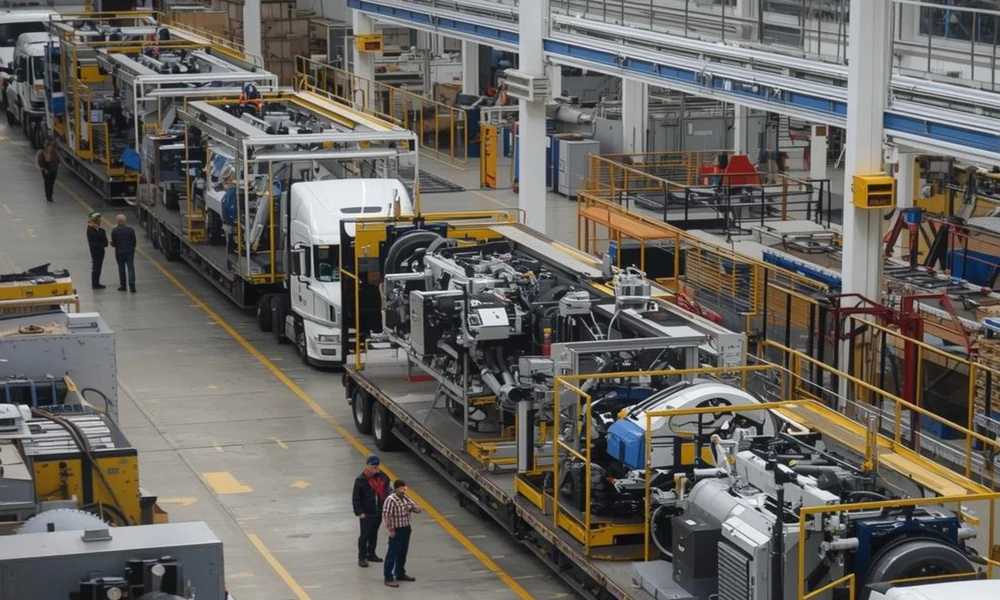
Moving an industrial facility is not simply a matter of transporting machinery from one building to another. Production lines, utilities, access routes, lifting equipment, specialist contractors and commissioning schedules all have to work together, often within a narrow shutdown window. That is why industrial plant relocation services rely so heavily on detailed sequencing and site planning before any major equipment is disconnected or moved. A successful relocation depends less on the ability to move one heavy machine and more on understanding how every stage affects the next, from isolation and dismantling through to transport, reinstallation, testing and eventual restart.
The complexity begins with the fact that industrial equipment rarely operates in isolation. A large machine may depend on power, compressed air, cooling water, extraction, data connections or specialist foundations, while upstream and downstream processes may rely on that machine being in a particular position. Moving it therefore affects more than the machine itself. It can affect the layout of the new site, the timing of other removals, the availability of cranes or forklifts and even the route other equipment must take through the building.
This is why relocation planning often begins with the sequence rather than the transport. If a machine needs to be the first item installed at the new site but is removed last from the old one, the entire move can become inefficient. Likewise, if an oversized piece of equipment blocks access to a doorway after it has been positioned, later machinery may no longer be able to enter. These are not minor logistical problems. They can create delays that ripple across the entire relocation schedule.
Sequencing Starts With Understanding Dependencies
One of the first tasks in any complex plant move is identifying which systems depend on which others. A packaging line, for example, might include conveyors, fillers, control panels, safety guarding, electrical cabinets and inspection systems. Removing one element too early could make another difficult to access or create unnecessary rework.
The same principle applies to utilities. Equipment may need to be isolated electrically before mechanical disconnection begins. Hydraulic or pneumatic systems may need to be depressurised. Process lines may need to be drained and cleaned. Data connections may need to be documented so controls can be restored correctly after the move.
Each of these activities has to happen in the right order.
A detailed sequence can therefore resemble a production schedule in its own right. Tasks are linked, dependencies are identified and specialist resources are allocated to particular stages. Some activities can happen simultaneously, while others must wait until a previous step is complete.
This becomes particularly important where downtime has to be kept to a minimum. If a facility cannot afford a long production stoppage, the relocation may need to be divided into phases. Certain machines can be moved first while others remain operational, or temporary processes may be put in place to maintain production while part of the plant is being relocated.
That sort of phasing requires careful planning because it changes the question from “How do we move the factory?” to “How do we move the factory while parts of it are still working?”
The New Site Has to Be Ready Before the Old One Is Taken Apart
A common source of delay in major moves is treating the new location as something that can be dealt with after the equipment has left the original facility. In practice, site readiness often determines whether the relocation stays on schedule.
Foundations may need to be constructed or reinforced. Floor loadings may need to be checked. Electrical supplies, compressed air, ventilation and drainage may all require modification before machinery arrives. If these services are not ready, equipment can end up sitting in storage or occupying floor space while contractors complete work that should already have been finished.
Space planning matters just as much.
Industrial layouts are rarely designed around machinery alone. Operators need room to work safely. Maintenance teams need access to service points. Forklifts and pallet trucks require travel routes. Finished products, raw materials and waste streams all have to move through the building without creating congestion.
A machine that technically fits within the allocated footprint may still be badly positioned if it restricts maintenance access or interferes with another production route.
This is why site surveys and dimensional checks are so important. Accurate measurements help determine whether machinery can pass through doors, around corners and beneath overhead structures. They also help establish whether cranes, gantries or other lifting equipment can be positioned where they are needed.
A relocation can become significantly more complicated if these details are discovered only when the equipment arrives.
Heavy Lifting Has to Be Built Into the Plan, Not Added Later
Large industrial machinery introduces another layer of complexity because it may require specialist lifting and rigging.
A heavy machine cannot always be moved directly from its operating position onto a transport vehicle. It may need to be raised, skated, jacked, dismantled or transferred using several pieces of equipment. The condition of the floor, available headroom and nearby structures can all influence the lifting method.
Planning the lift therefore involves much more than knowing the machine’s weight.
Its centre of gravity, lifting points, overall dimensions and sensitivity to movement may all need to be considered. Some machinery is relatively robust, while other equipment contains delicate alignments or components that can be damaged if the load is handled incorrectly.
The sequence again becomes critical. If lifting equipment is required for several machines, the move may be organised so that the same crane or gantry can be used efficiently rather than repeatedly mobilised and removed. That can save both time and cost, but only if the order of work has been planned around the availability of the equipment.
Transport vehicles create another constraint. Heavy or oversized loads may require special trailers, route planning or permits, depending on their dimensions and destination. If a particular machine must leave the old facility at a certain time but the correct vehicle is not available, the rest of the programme can quickly fall behind.
For this reason, lifting, transport and installation are best treated as one connected operation rather than three separate jobs.
Documentation Can Prevent Reinstallation Problems
Dismantling equipment is often easier than putting it back together correctly.
A machine that has been operating in the same location for years may contain modifications, additional wiring or adjustments that are not fully reflected in original drawings. If these details are not documented before disconnection, reinstallation can involve unnecessary troubleshooting.
Photographs, labels, connection records and updated drawings can all help.
Cables can be marked. Pipework can be identified. Components can be tagged according to their original position. Where complex systems are involved, creating a structured record before dismantling can reduce uncertainty when the equipment reaches the new site.
This is particularly important for older machinery.
Over time, maintenance teams may have adapted equipment to suit changing production requirements. A control cabinet may contain circuits added long after installation. Pipework may have been rerouted. Safety systems may have evolved. The actual machine may therefore differ from whatever documentation was originally supplied.
Relocation creates an opportunity to capture this information properly.
It can also reveal issues that should be addressed before reinstallation. Damaged cables, worn hoses, outdated guarding or difficult access points may be easier to correct while the equipment is already offline.
That said, introducing too many additional improvements during a time-critical relocation can create its own risk. Every extra modification adds tasks, decisions and potential delays. Good planning helps distinguish between essential work that should be completed during the move and improvements that can reasonably wait until production has restarted.
Commissioning Has to Be Part of the Sequence Too
The move is not complete when the machine is bolted to the floor.
Utilities must be reconnected, controls verified and safety systems checked. The equipment may need levelling, alignment or calibration before it can operate correctly. Trial runs may be required before full production resumes.
This stage can expose issues that were not obvious during dismantling.
A machine may have shifted slightly during transport. A sensor may need adjustment. A utility connection may not provide the pressure or capacity expected. A conveyor that worked perfectly in the previous factory may require alignment because the new floor has different levels.
If commissioning has been treated as an afterthought, these problems can delay restart.
A stronger approach builds testing into the relocation programme from the beginning. Sufficient time is allocated for electrical checks, mechanical inspection, dry runs and production trials. Technical personnel who understand the equipment are scheduled to be available when needed, rather than being called in only after a problem appears.
This is another example of sequencing extending beyond movement. Installation, testing and handover are all dependent on what happened before them.
Good Planning Creates Flexibility When Things Change
Even the most detailed relocation plan needs room for adjustment.
Industrial environments rarely behave exactly as predicted. A machine may take longer to disconnect than expected. A delivery vehicle may be delayed. A component may be damaged during removal and require repair before installation. Site work may uncover an unexpected structural issue.
The value of a detailed plan is not that it guarantees nothing will go wrong. It is that it makes the consequences of a problem easier to understand.
If planners know which tasks depend on a delayed machine, they can decide whether other work can be brought forward. If several installation teams are operating simultaneously, resources can be redirected instead of simply waiting.
That is far easier when the programme is clearly sequenced.
Relocation planning therefore benefits from identifying critical activities as well as alternative paths. Some tasks may have very little scheduling flexibility because everything else depends on them, while others can move by several hours or days without affecting final completion.
Understanding the difference helps teams respond intelligently when conditions change.
Ultimately, an industrial plant relocation is a systems project. Machinery, people, utilities, vehicles, contractors and production schedules are all connected, and moving one element affects the others.
Detailed sequencing turns that complexity into something manageable.
The strongest relocation plans consider removal and installation together, prepare the destination before equipment arrives and treat commissioning as part of the move rather than the final afterthought. They also leave enough flexibility to deal with the unexpected without losing sight of the overall schedule.
Heavy machinery may be the most visible part of a plant relocation, but the real work begins long before the first lift takes place. It is the sequence behind the move that determines whether dozens or hundreds of individual tasks eventually come together as one coordinated transition.